
Yes, you can run water from a Lake Hartwell or Lake Keowee house to the boat dock, and the way it’s done on a steep lakefront lot is a directional bore: a continuous HDPE line pulled from a pit near the house down the slope to a pit at the dock landing, beneath the retaining walls, terraced beds, and stone paths, with no trench cut down the hillside. Sloan Underground Construction, a family-owned contractor founded in 1965 and licensed in South Carolina (General Contractor license #14665), bores these runs on Hartwell, Keowee, and Jocassee lots from its base in Fountain Inn. Here’s how the job works, which shoreline rules apply on each lake, why a lake lot is a different animal than a subdivision yard, how the line is winterized, and what it costs.
Can you run a water line from the house to the dock?
Yes, Sloan Underground Construction runs house-to-dock water lines by horizontal directional drilling. A steerable drill head bores a path beneath the slope, and the new pipe is pulled back through that path in one piece, so the slope above it is never opened.
The water comes from a tee on the house’s existing service line or from a dedicated hose bib circuit, and it ends at a frost-proof riser or hose station at the dock landing, for washing down the boat, rinsing gear, filling a cooler, or feeding a dock-side sink.
The reason boring is the default on a lake lot is simple: everything you’ve built between the house and the water is in the way. A trench has to go through the retaining wall, the terraced landscaping, the flagstone steps, and the root zones of the shoreline hardwoods you were told to leave standing. A bore goes under all of it. The only excavation is a pit at the top of the run and a pit at the bottom, both backfilled and seeded.
The line itself is continuous HDPE: flexible, corrosion-proof, and jointless from end to end, which matters when the pipe is buried under a wall you never want to open again. Our comparison of pipe materials for water service lines covers why HDPE is the trenchless standard.
What permits and rules apply on Hartwell vs. Keowee and Jocassee?
Docks and shoreline work on Lake Hartwell fall under the U.S. Army Corps of Engineers, while Lake Keowee and Lake Jocassee shoreline work goes through Duke Energy Lake Services. Confirm the rules for your specific lot, plus any HOA review, before drilling is scheduled, because someone other than the homeowner controls the land at the water’s edge.
| Where | Who controls it | What to confirm |
|---|---|---|
| Lake Hartwell | The U.S. Army Corps of Engineers: Hartwell is a federal Corps project, and docks, shoreline work, and utilities that cross the shoreline zone fall under its Shoreline Management program, administered through the Hartwell Project office. | Ask the Corps what is required for your lot before the bore is planned; the upland portion on your own property is typically your call, and the portion at the shoreline is theirs. |
| Lake Keowee and Lake Jocassee | Duke Energy: both are Duke Energy hydro lakes, and shoreline structures and any work inside the project boundary go through Duke Energy Lake Services. | The process is different from the Corps process; the boundary line on your survey tells you where Duke’s jurisdiction begins. |
| HOA and architectural review | Keowee Key, The Cliffs at Keowee, the Reserve at Lake Keowee, and many Hartwell subdivisions add their own architectural review or HOA approval on top of the lake authority’s. | Get that sign-off in writing too. A bore is the least visible way to do the work, which tends to make review boards comfortable. |
Sloan Underground works within whatever the lake authority and the community approve; the bore path, the pit locations, and the riser location are all planned to fit the permit, not the other way around.
Why is a lakefront lot harder than a subdivision lot?
A lakefront lot is harder than a subdivision lot because of five problems a flat Greenville subdivision lot never shows: grade, granite, length, hardscape and landscaping, and trees. Each one makes an open trench slower, riskier, or more destructive, and each is something a bore passes beneath.
- Grade. The house sits at the top, the dock sits at the bottom, and the drop between them can be 30, 50, or 80 feet of elevation. An open trench on that slope is hard to stage, hard to keep safe, and washes out in the first summer thunderstorm.
- Granite. Keowee and Jocassee lots sit on granite shelf and boulders. Hartwell shorelines mix red clay with rock. A trench through rock is slow and brutal; a bore steers around what it can and grinds through what it must.
- Length. Dock runs are long — 200 feet is common, and 400 to 600-plus feet is not unusual on a deep lot. Long runs favor boring, because the crew mobilization is spread over more footage. Our guide to the cost to run a water line 500 or 1,000 feet goes into the math.
- Hardscape and landscaping. Retaining walls, terraced planting beds, flagstone steps, irrigation, landscape lighting, and seawalls at the bottom. Every one of them is something a trench destroys and a bore passes under.
- Trees. Shoreline hardwoods are often protected by the lake authority or the HOA, and trenching through their root zones is how they die two years later. Our post on whether trenching kills trees explains what boring avoids.
Bore Once, Pull Everything
If you are already boring to the dock for water, that same bore path can carry electric conduit for dock lighting, a boat lift, or a lake pump, and a fiber or telecom conduit if you want connectivity at the water. Sloan Underground can pull water, electric, and fiber through the same bore path on Lake Hartwell, Lake Keowee, and Lake Jocassee lots. Planning the bundle up front is far cheaper than boring the slope twice.
How does the house-to-dock bore run, step by step?
A house-to-dock bore runs in four steps: a free site visit, locate and plan, bore, ream and pull, and restoration. The details below follow that order on a lakefront lot, from the first walk down the slope to the moment water comes out at the landing.
- Free site visit. The crew walks the slope from the house to the water, measures the run, notes the walls, steps, trees, irrigation, and the lake-authority boundary, and writes a line-item estimate.
- Locate and plan. An SC811 locate request marks every buried utility on the lot, existing utilities are hand-exposed where needed, and the crew plots a bore path that clears the walls, roots, and landscape. The entry pit goes near the house at the tee point on the service line (or at the hose bib circuit feeding the run); the exit pit goes above the shoreline at the spot the permit allows the riser, the only digging near the water.
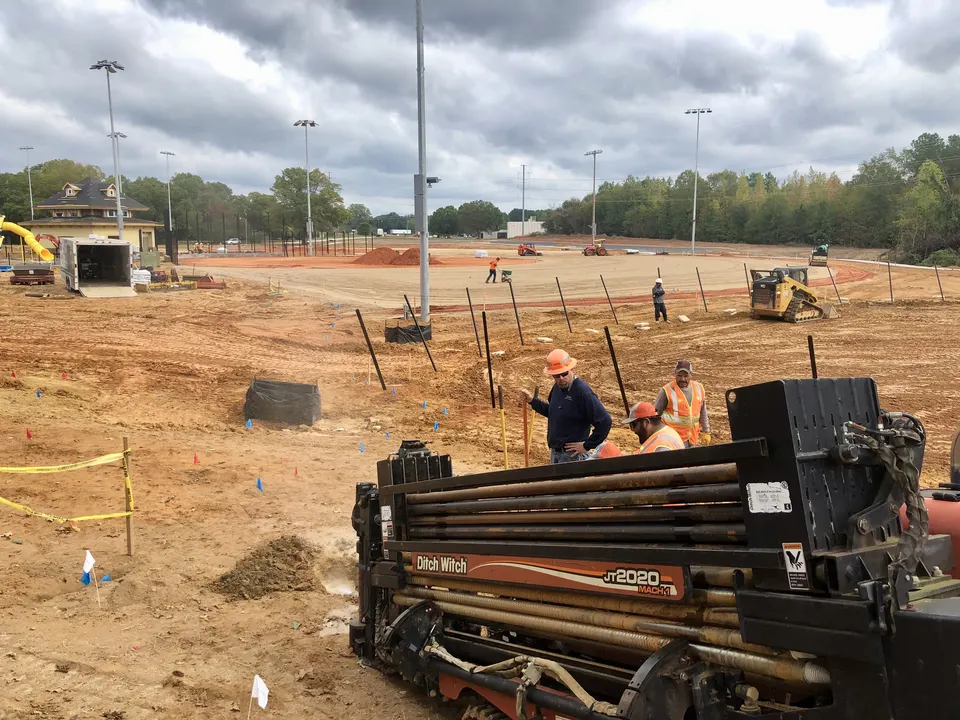
- Bore, ream and pull. The Ditch Witch drill steers the pilot path down the slope while a locator above ground reads depth and pitch every few feet, keeping the line below frost depth and clear of roots, walls, and rock the crew chose to avoid. The pilot hole is opened to size and the continuous HDPE line is pulled back through in one piece, with no joints buried under the hillside. The run gets a shutoff valve at the house end, a drain-down or blowout point at the low end so it can be emptied before winter, a frost-proof riser or hose station at the dock, and backflow protection where it ties into the house service. The line is then pressure-tested.
- Restoration. Both pits are backfilled and seeded, the site is cleaned up, and the crew walks the property with the customer before leaving. Most dock runs are finished in a single day.
The same process is what puts a standard service line in without touching the lawn — our walkthrough of installing a water line without yard damage shows the two pits and the pull in more detail. On a lake lot, the only difference is the grade and the permit.
What does a house-to-dock water line cost?
A house-to-dock water line typically lands between a few thousand dollars and the low five figures, depending on total length, rock, and hardscape. Published directional boring rates in South Carolina run roughly $15–$45 per foot, and long dock runs usually land toward the lower end because the rig, crew, and mobilization are spread across more footage.
What moves the number on a lake lot specifically:
- Total length — the single biggest variable; a 150-foot run and a 500-foot run are different jobs
- Rock — granite shelf on Keowee and Jocassee slows the bore and can require a different bit and more time
- Hardscape crossings — the bore passes under walls and steps without cutting them, but each crossing is planned depth and steering the crew has to earn
- What rides along — adding electric or fiber conduit to the same pull adds material but almost no extra boring
- Permits: lake-authority and HOA fees are set by those bodies, not by the contractor, so confirm them with each
For the general math behind per-foot pricing, mobilization, and why short bores cost more per foot than long ones, see directional boring cost in South Carolina. Anyone quoting a firm dock-run price over the phone without seeing the slope is guessing.
What happens at the site visit and written estimate for a dock water line?
Sloan Underground Construction’s site visit is free: the crew walks from the house to the water, measures the actual run, and writes a line-item price. The crew notes the walls, steps, trees, and lake-authority boundary, checks where the tee and the riser can go, and identifies the two pit locations.
The written estimate lists boring, pipe, valve and drain-down, riser, backflow, and testing as line items before anything is scheduled, along with a clear list of what the lake authority and your HOA will need from you.
Sloan Underground Construction serves the lake communities of Oconee County, Pickens County, and Anderson, and installs water lines across the rest of the Upstate. Call (864) 386-1649 or send the address to set up the site visit, and find more lake-lot guides in the Sloan Underground blog.
Frequently Asked Questions
Can you run a water line from my house to my boat dock on Lake Hartwell?
Yes, a water line can be run from your house to a boat dock on Lake Hartwell. A directional drill bores a path from a small pit near the house down the slope to a pit at the dock landing, then pulls a continuous HDPE water line back through it. Retaining walls, terraced landscaping, stone paths, and tree roots stay in place because the line passes beneath them. Sloan Underground bores these runs on Lake Hartwell, Lake Keowee, and Lake Jocassee lots.
Do I need a permit to run a water line to a dock on Lake Hartwell or Lake Keowee?
Usually, yes, a permit is needed for the portion of the line near the shoreline. Lake Hartwell is a U.S. Army Corps of Engineers project, and work in the shoreline zone falls under the Corps Shoreline Management program through the Hartwell Project office. Lake Keowee and Lake Jocassee are Duke Energy lakes, and shoreline structures and work inside the project boundary go through Duke Energy Lake Services. Many lake communities add an HOA or architectural review step. Confirm the requirements for your specific lot before any work starts.
How much does a house-to-dock water line cost?
A house-to-dock water line typically costs between a few thousand dollars and the low five figures. Published directional boring rates in South Carolina run roughly $15 to $45 per foot, and long runs usually land toward the lower end because the crew and rig mobilization is spread across more footage. Where a run lands depends on total length, how much granite is in the path, and what hardscape the bore has to pass beneath. The site visit and written estimate are free and give you a firm number.
Will the dock water line freeze in winter?
The dock water line can freeze in winter if it is built wrong. The buried section is placed below frost depth, and the exposed riser at the dock is the vulnerable part. The line is installed with a shutoff valve at the house end and a drain-down or blowout point at the low end so the whole run can be emptied before a hard freeze and turned back on in spring.
Why not just trench down the hill to the dock?
A trench down a steep lakefront lot is a poor choice because it means cutting through retaining walls, terraced beds, stone steps, and the root zones of shoreline trees, then rebuilding all of it. The slope also makes an open trench hard to stage, hard to keep safe, and prone to washing out in a summer storm. A bore places the line beneath everything in a single pull, and the only excavation is a pit at each end.
Related Articles
Trenching vs. Directional Boring for Upstate SC Lake Homes
When an open trench still makes sense, when it doesn’t, and why steep, rocky lake lots almost always favor the bore.
Read article
Install a Water Line Without Damaging Your Yard
How trenchless installation bores beneath the lawn — the full process, step by step, and what it costs in SC.
Read article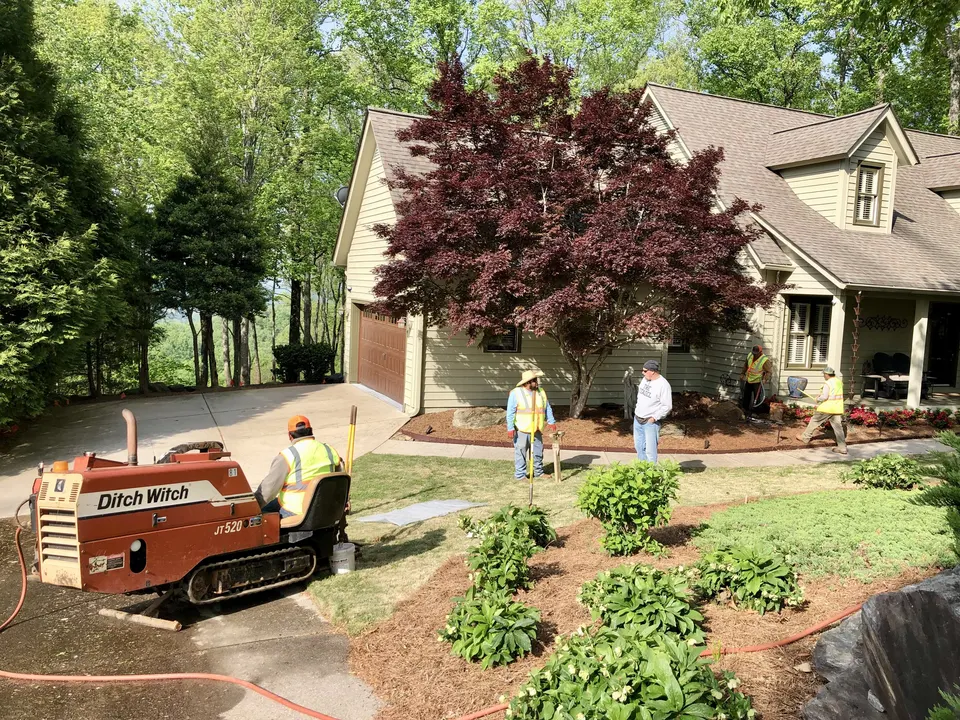
Water Line Replacement Cost at Lake Keowee & Hartwell Homes
Per-foot math for 150–400 ft lake runs, and what rock, slope, walls, and shoreline approvals add.
Read article