
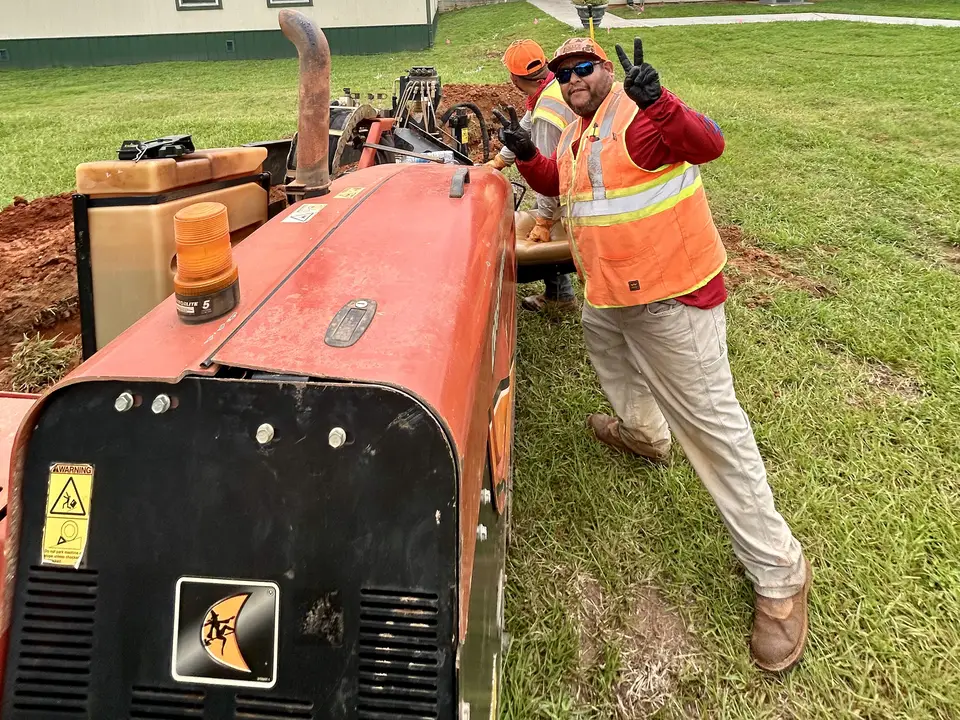
Sloan Underground Construction takes directional boring as a subcontractor on data center sites: we bore the conduit for power and fiber and the water and gas lines under roads, paving and live utilities, so your site stays open while the utilities go in. If you are an owner, developer or general contractor with crossings on your utility plan, this page covers what we take on, how we work under your schedule, and what to send us for a price.
What does a boring subcontractor do on a data center site?
A boring subcontractor places conduit and pipe beneath the parts of a data center site that cannot be dug up. A drill rig launches from a small pit, steers a pilot bore along a planned path, then pulls the conduit or pipe back through the hole. The surface between the two pits is never opened.
A data center is a utility project as much as a building project. Power arrives in buried conduit, fiber arrives in its own ducts, and water and gas lines feed the mechanical yard. Most of that runs in open trench across graded ground. The exceptions are the crossings: the entrance road, a perimeter road, a paved yard, a fence line with security conduit, or a corridor of utilities that went in during an earlier phase. Those are the places a bore earns its keep.
Our horizontal directional drilling page explains the method step by step, and how a bore crosses a road covers the permit side of a public road crossing.
Which data center utility scopes can you subcontract to us?
You can subcontract the bored crossings for power feeder conduit, fiber and communications ducts, water lines, gas lines and site lighting and security conduit. These are scopes Sloan Underground already installs on residential and commercial jobs; the table shows where each one calls for a bore.
| Utility | What gets placed | Why it is bored |
|---|---|---|
| Power | Conduit for feeders between the utility connection, yard equipment and buildings | Crosses roads and paved yards without a saw cut or a patch |
| Fiber and communications | Dedicated ducts, often entering the site from more than one direction | Separate entry paths have to cross the perimeter and existing lines |
| Water | Service and supply lines to the building and mechanical yard | Passes under roads and other utilities at a steady depth |
| Gas | Service lines for generators and building equipment | Keeps the line clear of paving and other trenches |
| Site lighting and security | Conduit to poles, gates and cameras along the perimeter | Runs under finished drives, curbs and fence lines |
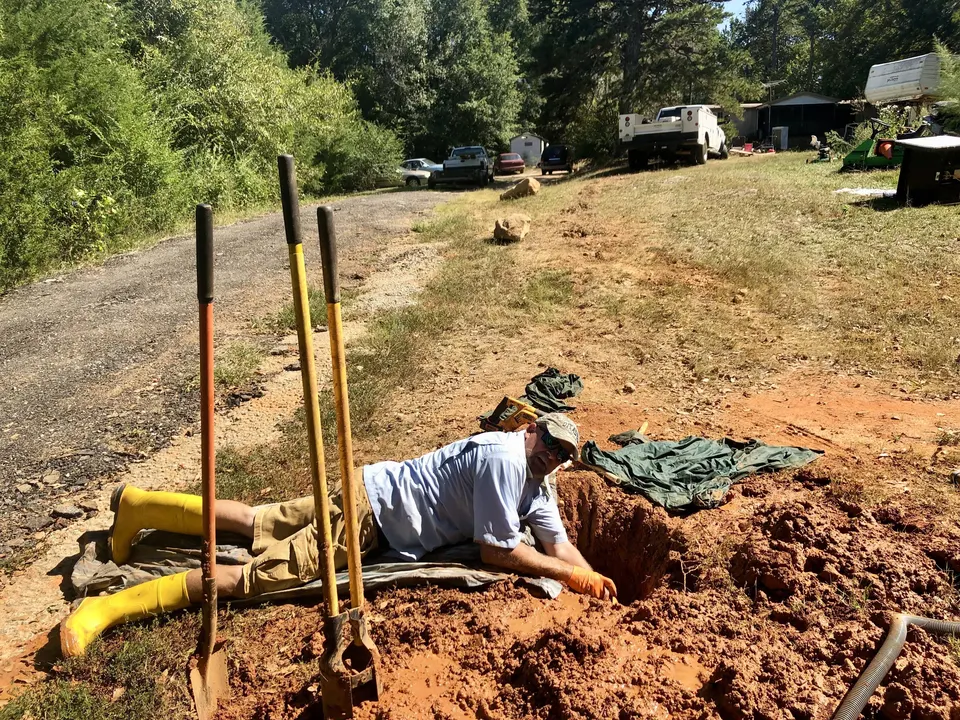
Fiber is the clearest case. A data center usually wants its fiber to come in by separate routes, so that one damaged path does not take the site offline. Separate routes mean separate crossings of the property line, and each one has to pass roads and utilities that are already there. Our guide to fiber optic cable installation in South Carolina covers how fiber ducts are placed and handed over, and underground conduit systems, explained covers duct banks, sweeps, pull boxes and spare ducts.
Why sub out the crossings instead of trenching them?
Crossings are subbed out to a boring crew because the site keeps working while it is being built. Campuses go up in phases, so by the time the second building needs power and fiber, the roads, parking and first-phase utilities are already in use. A bore goes under them; a trench goes through them.
- Roads stay open. Construction traffic, deliveries and staff keep using the entrance while the conduit goes in beneath it.
- Live utilities are left alone. The bore path is planned to pass under or beside existing lines after they have been located and exposed.
- Pavement is not cut. There is no trench patch to settle later in a truck route.
- Less ground is disturbed. Two small pits replace a full-length trench, which matters next to finished grading and landscaping.
Trenching is still the right call across open, ungraded ground with nothing to cross. Most utility packages use both: your site contractor trenches the long open runs, and a boring subcontractor takes the crossings. Our comparison of trenching and directional boring walks through the same trade-off on a smaller scale.
How do we work around the utilities already on your site?
We plan every bore in four steps: locate, expose, drill, record. Every project starts with an 811 locate request, and on a private campus that is only the start, because lines the owner installed are not marked by the public locate. We need your site utility drawings for those.
- Locate. Call 811 for the public utilities, and get the site utility drawings and a private locate for everything inside the fence.
- Expose. Dig down to the lines the bore will cross so their real depth is seen, not assumed.
- Drill. Steer the pilot bore along the planned path, tracking the drill head from the surface, then pull the conduit or pipe back through.
- Record. Hand over where the line actually runs and how deep, so your next phase can work around it.
Skipping the second step is how utilities get hit. Our article on what happens if you hit an underground utility explains why a marked line still has to be exposed before a drill passes it.
Which crossings fit our rigs?
The drill has to match the crossing. Bore length, pipe or bundle diameter and soil decide the rig, and no single machine covers every job on a large site. Compact and mid-size rigs handle service-size conduit, water and gas lines and conduit bundles on road and yard crossings. Very long or very large-diameter crossings need a larger class of rig.
Sloan Underground Construction runs Ditch Witch JT-5, JT-520 and JT-2020 directional drills. That fleet is sized for the crossings that make up most of a site utility package: conduit under roads and paved yards, water and gas services, and fiber ducts along a perimeter. Send the drawings and we will tell you plainly which crossings fit our rigs and which do not.
Soil matters as much as size. Upstate red clay drills predictably; rock changes the tooling and the schedule. Our article on directional boring through rock covers what that means for a bid.
What do we need from you to price the work?
To price a boring scope we need five things: the utility drawings, the crossings, the pipe at each crossing, what you know about the ground, and your schedule. Send what you have; we can start from a marked-up site plan.
- Site utility drawings. Existing and proposed, including anything installed in earlier phases.
- The crossings. A list or markup of each road, yard or utility corridor to be bored, with rough lengths.
- What goes in each one. Conduit or pipe size, material and count, so the bundle and the rig can be matched.
- Ground conditions. Any geotechnical report or known rock.
- Schedule and access. When each area is available and any site rules for subcontractors.
Beyond drilling, our crews place the conduit, pipe and boxes: see conduit placement and commercial underground utilities. Sloan Underground has worked in underground utilities since 1965 and holds SC General Contractor license #14665. Call (864) 386-1649 or use the form on this page to send the scope.
If you are comparing subcontractors, our checklist on how to choose an underground utility contractor lists what to verify.
Frequently Asked Questions
Does Sloan Underground work as a subcontractor on data center projects?
Yes. Sloan Underground Construction takes directional boring and underground utility scopes as a subcontractor to owners, developers, general contractors and site utility contractors. Send the utility drawings and the crossings you want priced, and we will tell you which ones fit our rigs.
Which data center utility scopes can be subcontracted to a boring contractor?
The crossings: conduit for power feeders, conduit for fiber and communications, water lines, gas lines, and conduit for site lighting and security. These are the runs that pass under roads, paved yards, fence lines and utilities already in service, where an open trench is not practical.
What do you need from us to price a boring scope?
The site utility drawings, a list or markup of the crossings, the conduit or pipe size and count at each one, any soil or rock information you have, and the schedule window. With those we can price each crossing and flag any that need a larger rig than ours.
Where does Sloan Underground take data center subcontract work?
Sloan Underground works across Greenville and Upstate South Carolina, the Midlands and Western North Carolina. The company has worked in underground utilities since 1965 and holds SC General Contractor license #14665.
Related Articles
Fiber Optic Cable Installation in South Carolina
How commercial and residential fiber projects work — boring, burial depth, and ISP coordination.
Read article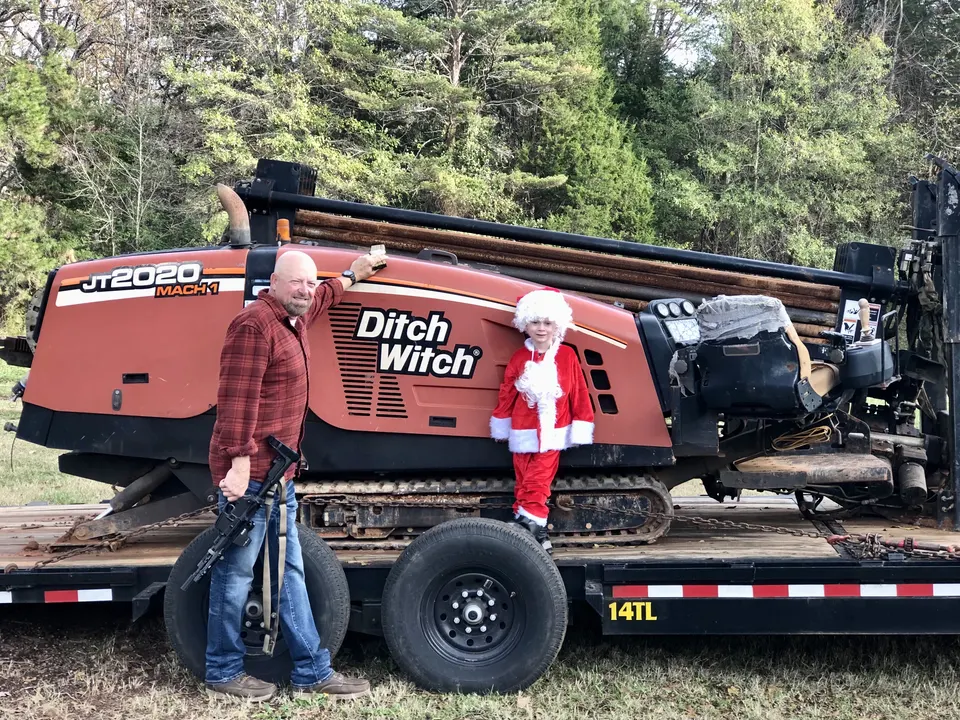
How Do You Bore Under a Road?
The full crossing walkthrough — pilot bore, steering, pull-back, and what permits are involved.
Read article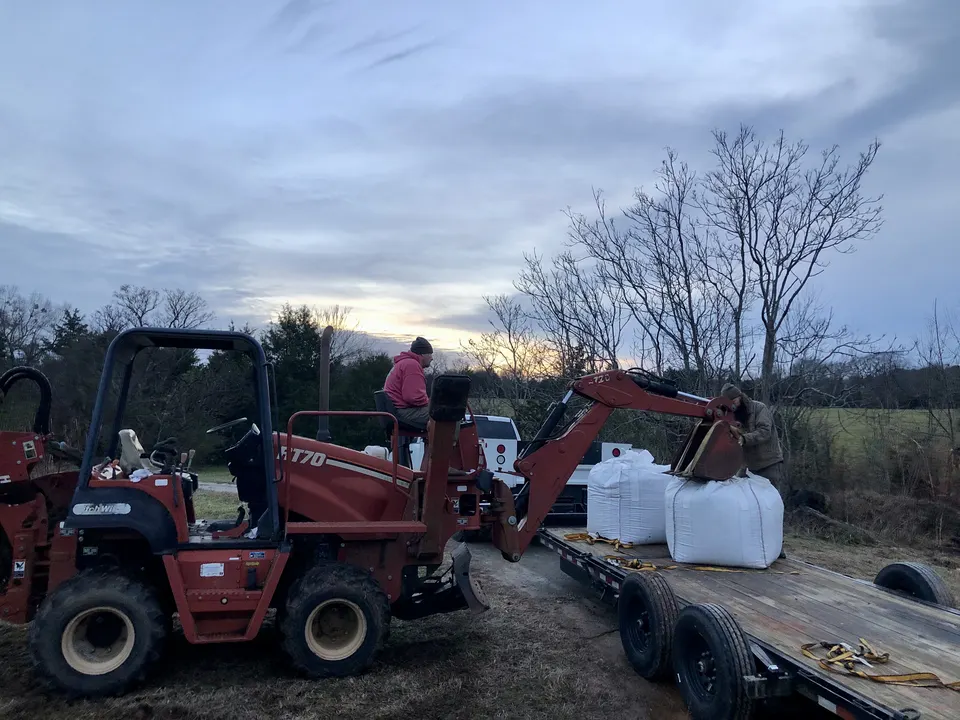
What Happens If You Hit an Underground Utility?
Why locates come first on every job — and what a strike costs when a buried line has no conduit.
Read article