
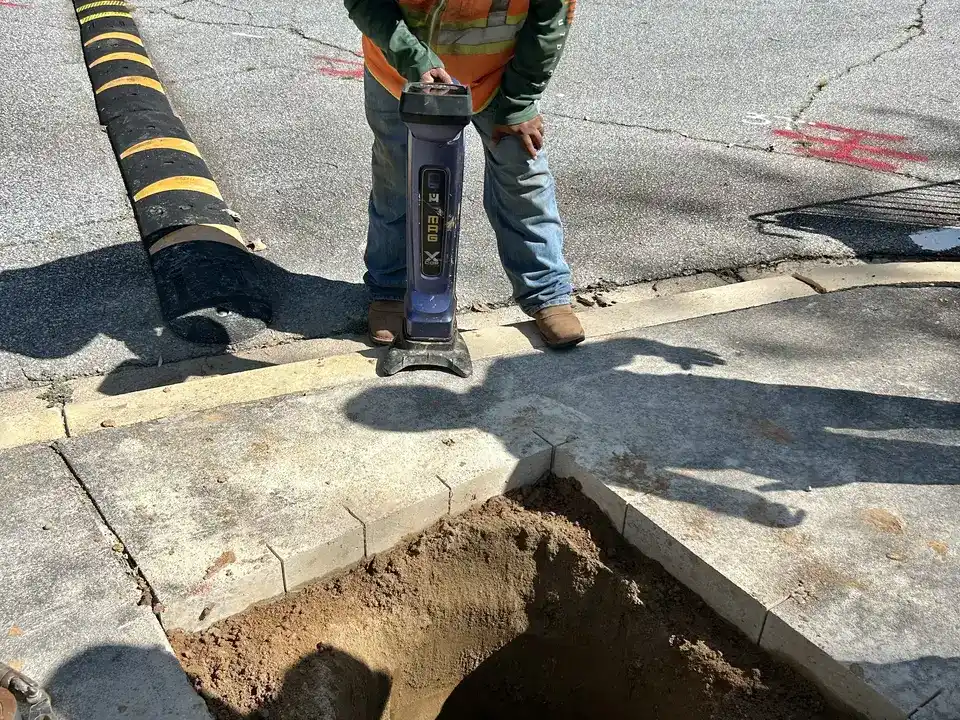
Sloan Underground Construction takes underground drilling as a subcontractor on data center sites that are already operating: new conduit, water and gas lines are bored beneath roads, paving and in-service utilities from two small pits, so nothing on the campus has to be shut down or dug up to add them. The work is mostly preparation: finding and exposing what is already there before the drill moves.
Can utilities be bored on a data center that is already operating?
Yes. New utilities can be bored on an operating data center because the drill passes under the surface and under the existing lines, opening the ground only at a launch pit and an exit pit. Roads stay open and nothing in service is disturbed, provided every line on the bore path has been located and exposed first.
This is the usual situation on an expansion. The first building is live, and the next one needs power conduit, fiber duct, water and gas brought across ground that already carries the first building's utilities. Our overview of working as a directional boring subcontractor for data centers covers the scopes we take on; this page covers what changes when the site is live.
What makes a live campus different from a new site?
A live campus differs from a new site in one way that matters: the ground is already full, and what is in it cannot go down. Everything else follows from that.
| New site | Operating campus | |
|---|---|---|
| What is in the ground | Little or nothing | Power, fiber, water and gas in service |
| Who knows where it is | The civil drawings | Site records, which may not match what was built |
| Public locate (811) | Covers the utility lines at the edge | Does not cover owner-installed lines inside the fence |
| Surface | Graded dirt | Finished roads, paving and landscaping |
| Access | Open | Controlled, with site rules for subcontractors |
How do we keep a drill clear of in-service lines?
We keep the drill clear of in-service lines by seeing them before we pass them. Paint marks and drawings show roughly where a line is; only exposing it shows the depth.
- Gather the records. Site utility drawings and any records from earlier phases.
- Locate. An 811 ticket for the public utilities and a private locate for the owner's lines.
- Expose. Dig down to each line the bore will cross and measure its real depth.
- Plan the path. Set the bore to pass each line with the clearance your engineer or the utility requires.
- Track the drill. Follow the drill head from the surface for the length of the bore.
- Record. Hand over the path and depth of the new line so the site records stay current.
Our article on what happens if you hit an underground utility explains why step three is the one that cannot be skipped.
How much of the site does a bore disturb?
A bore disturbs two pits and the staging area for the drill, not the length of the run. On a paved area, the opening is a square cut at each end where the new line ties in, and the paving between them is untouched.
That matters on a site with finished roads, striped parking and security fencing. A trench across an entrance road means a closure, a plate or a detour. A bore under it means a drill parked to one side. Our horizontal directional drilling page shows the method, and trenching versus directional boring compares the two.
What site rules can a drilling subcontractor work under?
A drilling subcontractor works under whatever rules the site sets, as long as they are known before the bid. Access rules change crew time, so they belong in the scope, not in a surprise on the first morning.
- Access. Badging, background checks and escort requirements for the crew.
- Dig permits. The site's own permit-to-dig process, on top of 811.
- Work windows. Hours and days when drilling is allowed.
- Staging. Where the drill, the conduit and the spoil can sit.
- Stop rules. Who to call, and what stops work, if something unexpected is found.
What do we need from you to price work on a live site?
To price work on a live site we need the new routes, the existing records and the site rules. The more of the existing utility information you can share, the tighter the price.
- The expansion drawings with each new route and crossing marked.
- Existing utility records for the area, including earlier phases.
- What goes in each bore: conduit or pipe size, material and count.
- Site rules and schedule: access, dig permits, work windows.
Beyond drilling, our crews place the conduit, pipe and boxes: see conduit placement and commercial underground utilities. Sloan Underground has worked in underground utilities since 1965 and holds SC General Contractor license #14665. Call (864) 386-1649 or use the form on this page to send the scope.
Frequently Asked Questions
Can new utilities be bored on a data center that is already operating?
Yes. Directional boring passes new conduit and pipe beneath roads, paving and in-service utilities from two small pits, so the campus keeps running. The work depends on locating and exposing every existing line the bore will cross before drilling starts.
Does 811 mark the utilities inside a data center campus?
No. 811 marks the lines owned by member utilities, usually up to the meter or the property line. Power, fiber, water and gas lines the owner installed inside the fence are private and need the site utility records and a private locate.
Does Sloan Underground take this work as a subcontractor?
Yes. Sloan Underground Construction takes underground drilling scopes as a subcontractor to owners, general contractors and site utility contractors. Send the expansion drawings, the existing utility records and your site rules for a price.
What site rules do you need to know before pricing?
Access and badging requirements, work hours, the dig permit process, any areas that need an escort, and where equipment and spoil can be staged. Those affect crew time as much as the bore length does.
Related Articles
Directional Boring Subcontractor for Data Centers
What we take on as a boring subcontractor and what to send for a price.
Read article
What Happens If You Hit an Underground Utility?
Why a marked line still has to be exposed before a drill passes it.
Read article
How Do You Bore Under a Road?
Permits, pits and how a road crossing is drilled.
Read article