
The fastest way to confirm a hidden underground water leak is the meter test: shut off every fixture, watch the meter's leak indicator for 10–15 minutes, and if it moves, water is escaping somewhere on your property. In the Upstate — Greenville, Spartanburg, Anderson, Travelers Rest, Powdersville, and across Pickens County — dense red-clay soil hides most service-line leaks completely, so the yard can look bone-dry while thousands of gallons drain away underground. Here's how to spot the warning signs, run the test yourself, and understand what professional water leak detection involves once you've confirmed a leak.
What Are the Signs of a Hidden Underground Water Leak?
The four classic signs of an underground water leak are an unexplained water bill spike, a meter that moves with every fixture off, a house-wide drop in water pressure, and wet or soft spots in the yard along the service-line path. Because Upstate clay masks surface symptoms, the bill and the meter are usually the first honest witnesses.
A Water Bill That Jumps Without Explanation
A service-line leak runs 24 hours a day, so even a modest one adds real gallons to every billing cycle. If your usage climbs while your habits haven't changed — no houseguests, no new irrigation, no filled pool — a hidden leak is the leading suspect. Our guide on why your water bill is so high walks through the other culprits to rule out first.
A Meter That Moves With Everything Off
Your water meter is the single most reliable leak detector on the property. With every fixture and appliance shut off, the meter should be perfectly still. If the low-flow triangle or sweep dial keeps creeping, water is leaving the line somewhere. See our full breakdown of why a water meter keeps spinning and what each indicator on the register means.
Pressure Drop at Every Faucet
A leak bleeds pressure out of the line before water reaches the house, so every fixture weakens at once — showers, sinks, and outdoor spigots together. One weak faucet is a fixture problem; a whole-house drop points at the service line. The decline is usually gradual, which is why many homeowners in Greenville and Spartanburg don't register it until the leak is well established.
Wet, Soft, or Unusually Green Patches
When a leak does surface, it shows up as a persistently damp or spongy strip of yard, a patch of grass greener than everything around it, or standing water with no rain to explain it — usually somewhere along the straight line between the meter box and the foundation. For the complete symptom list, read signs your water line is leaking.
How Do You Do the DIY Water Meter Leak Test?
The meter test takes about 20 minutes, costs nothing, and tells you two things: whether you have an active leak, and which side of the foundation it's on. Shut off all water use, watch the meter's leak indicator, then close the main house shutoff and watch again — continued movement means the leak is in the buried line.
- Shut off every fixture and appliance. Faucets, showers, toilets (make sure none are running), washing machine, dishwasher, ice maker, and any irrigation or sprinkler timers. Everything that touches water goes quiet.
- Find your meter and its leak indicator. The meter sits in a ground-level box near the street or property line. Most registers have a small triangle, star, or snowflake-shaped low-flow indicator that spins with even tiny flow; digital meters show a flow-rate or leak icon.
- Watch for 10–15 minutes. With all water off, the indicator should be dead still. Any movement — even slow, intermittent creep — means water is flowing through the meter and escaping somewhere downstream.
- Close the main interior shutoff and re-check. Shut the valve where the line enters your house, then look at the meter again. If the indicator stops, the leak is inside the house or under the slab. If it keeps moving, the leak is in the underground service line between the meter and the foundation.
- Log a reading overnight for slow leaks. Very small leaks may not visibly move the indicator. Write down the exact meter reading before bed, run no water overnight, and compare in the morning. Any difference is leakage.
Why Upstate Red Clay Hides Leaks
The Piedmont's dense red-clay soil — the same clay you hit a shovel-width down anywhere from Powdersville to Travelers Rest — is slow to let water through. Instead of surfacing above the break, leaking water follows the path of least resistance: along the outside of the pipe itself, through old utility trenches, or downslope through fill soil. It can emerge dozens of feet from the actual leak point, or never surface at all. That's why a dry yard proves nothing, and why the wet spot you do find often isn't where the pipe is broken.
What Does Professional Water Leak Detection Involve?
Professional leak detection combines three standard methods — acoustic listening, pressure isolation, and meter-flow analysis — to pinpoint a buried leak within a small area before any digging starts. The goal is to open one precise hole at the leak, not excavate the whole line hunting for it.
Acoustic Listening
Pressurized water escaping a pipe makes a distinct hiss or rushing sound that travels along the pipe wall and through the soil. Acoustic detection uses ground microphones and listening rods worked along the service-line path to find where that sound is loudest — which marks the leak point. Clay soil actually carries pipe noise reasonably well, which helps offset how thoroughly it hides visual evidence.
Pressure Isolation
By closing valves and isolating sections of the line, a technician can watch which segment loses pressure when sealed off. A section that can't hold pressure contains the leak; sections that hold steady are ruled out. On a typical residential service line this narrows the search from the whole run to a short stretch between two points.
Meter-Flow Analysis
The same principle as your DIY test, done with finer instruments: measuring exactly how much water moves through the meter under controlled conditions. Flow rate indicates the size of the leak, and comparing readings with different sections isolated confirms its location. It's also how a pro verifies, after the repair, that the line is completely tight again.
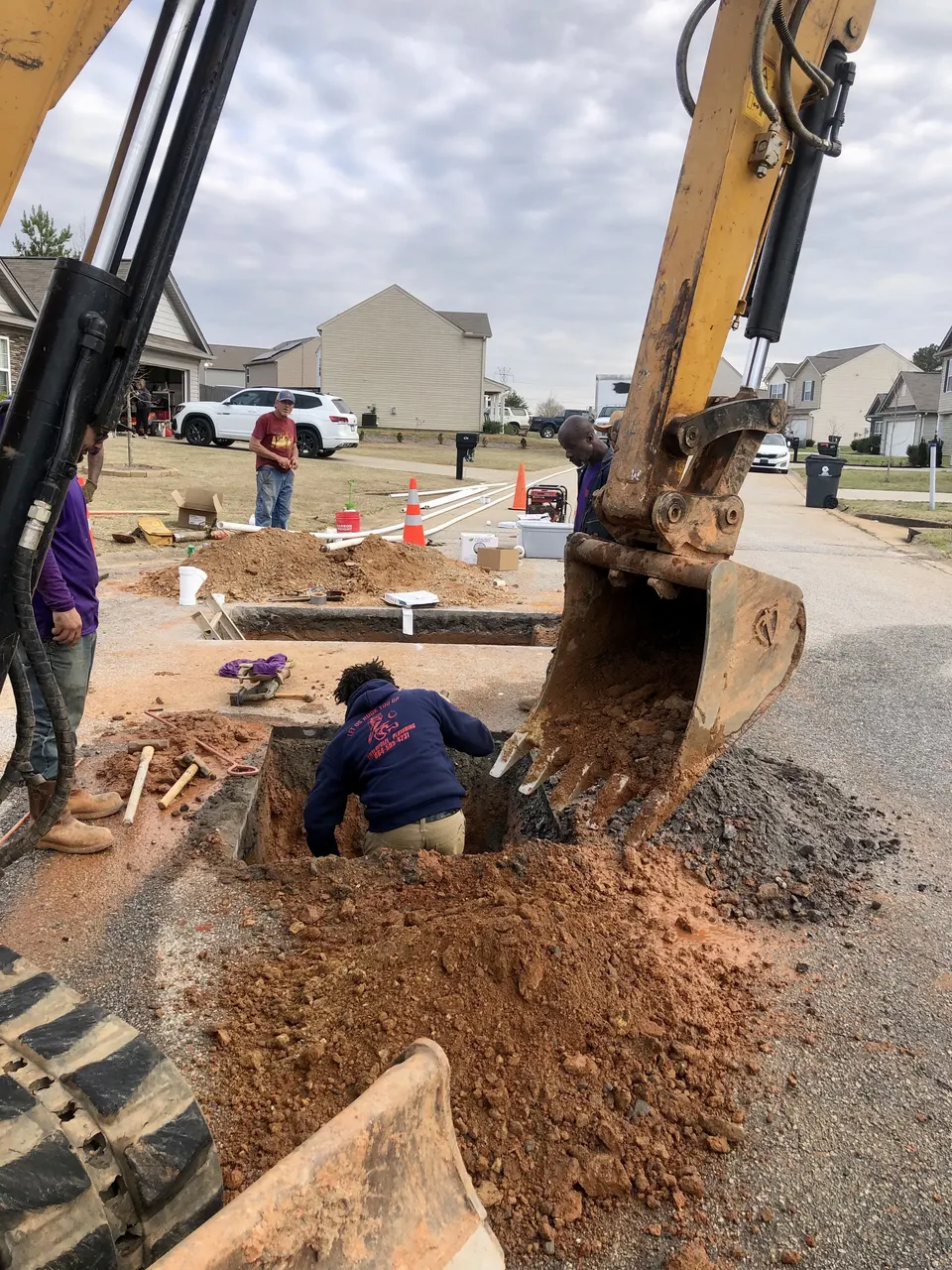
Sloan Underground Construction locates and repairs leaks on buried water service lines across the Upstate — Greenville, Spartanburg, Anderson, Travelers Rest, Powdersville, and Pickens County — as well as the Midlands and Western North Carolina. If your meter test came back positive, our water leak detection service starts with a free estimate.
What Are the Repair Options Once the Leak Is Found?
Once the leak is located, the choice comes down to a spot repair of the failed section or replacing the line — and in the Upstate, replacement is usually done trenchlessly, with a directional bore pulling new pipe beneath the yard instead of trenching through it. The right call depends on the pipe's material, age, and overall condition.
Spot Repair
When the leak is a single, isolated failure — a root strike, a damaged fitting, one bad joint — on a line that's otherwise sound, excavating just that point and replacing the failed section is the fastest, least expensive fix. Because professional detection pinpoints the break, the dig stays small and the rest of the yard is untouched.
Trenchless Line Replacement
If the line is old galvanized steel, thin-wall polybutylene, or has leaked more than once, patching one point just moves the problem down the pipe. Full water line replacement swaps the entire run for new pipe — and with directional boring, the new line is pulled through a bore beneath the yard, so there's no trench across the lawn, driveway, or landscaping. Sloan Underground runs Ditch Witch directional boring rigs for exactly this work throughout the Upstate.
When Should You Act on a Suspected Leak?
Act as soon as the meter test confirms movement — underground leaks never shrink, and every week of waiting is water on your bill and erosion under your yard. Left alone, a service-line leak can undermine driveways, walkways, and slab foundations as it washes soil away.
- Meter moves with the house shutoff closed — confirmed underground leak; schedule detection now
- Two consecutive high bills with no change in household use — run the meter test today
- Soft or sunken ground along the meter-to-house path — the leak may already be moving soil
- Sudden pressure drop across every fixture — the leak is likely growing
- Water in the meter box itself (with the box otherwise dry) — a common failure point worth checking first
Sloan Underground Construction serves homeowners across the SC Upstate — Greenville, Spartanburg, Anderson, Travelers Rest, Powdersville, and Pickens County — plus the Midlands and Western North Carolina. Call (864) 386-1649 for a free estimate, or start with our water leak detection page to see how the locate-and-repair process works.
Frequently Asked Questions
How do I know if I have an underground water leak?
The four most reliable signs are a water bill that climbs without any change in household use, a water meter that keeps moving with every fixture and appliance shut off, a drop in water pressure at every faucet, and persistently wet or soft spots in the yard between the meter and the house. Any one of these justifies a meter test; two or more together almost always mean an active leak on the buried service line.
How does the water meter leak test work?
Turn off every fixture and water-using appliance — faucets, ice maker, washing machine, irrigation timers — then watch the small leak-indicator triangle or dial on your water meter for 10 to 15 minutes. If it moves with everything off, water is escaping somewhere. Next, close the main shutoff valve where the line enters the house and check the meter again: if it still moves, the leak is in the buried service line between the meter and your foundation.
Who is responsible for a leak between the meter and the house?
In most Upstate SC water systems — including those serving Greenville, Spartanburg, and Anderson — the utility owns and maintains everything up to and including the meter, and the homeowner owns everything from the meter to the house. That buried service line is where most hidden leaks occur, and locating and repairing it is the property owner's responsibility. Check with your specific water provider, since a few districts draw the line slightly differently.
Can an underground water leak go unnoticed for months?
Yes — and in the Upstate it often does. The region's dense red-clay soil absorbs and channels leaking water instead of letting it surface, so a service-line leak can run for months with no puddle, no soggy grass, and no sound. Many homeowners only discover the leak after two or three high water bills in a row. That's why the meter test matters: it detects the leak even when the yard shows nothing.
Will an underground leak fix itself if I wait?
No. Pressurized water moving through a crack or failed joint erodes the surrounding soil and enlarges the opening over time, so leaks only grow. Waiting adds wasted water to every bill, can wash out soil beneath driveways and slabs, and turns a repairable defect into a full line failure. Once a meter test confirms an active leak, scheduling detection and repair promptly is always the cheaper path. Sloan Underground provides free estimates — call (864) 386-1649.
Related Articles
Signs Your Water Line Is Leaking
Wet spots, hissing sounds, low pressure, and high bills — the full symptom list for a leaking service line.
Read article
Why Is My Water Meter Spinning?
What a moving meter means with all fixtures off — and how to use it to isolate the leak's location.
Read article
Why Is My Water Bill So High?
Sudden bill spikes almost always mean a hidden leak — how to check the meter and find the culprit.
Read article