
Professional water leak detection in South Carolina typically costs $150–$600 for most residential properties, with slab leaks and long or complex service lines running $600–$1,200+. Those figures reflect typical industry pricing across the Upstate and Midlands as of 2026 — and detection is often bundled into the repair when the same contractor does both. Sloan Underground provides free estimates, so on many jobs the "find it" step costs you nothing.
How Much Does Leak Detection Cost in South Carolina?
Most South Carolina homeowners pay between $150 and $600 to have a water leak professionally located, based on typical industry pricing as of 2026. Simple above-slab or shallow yard leaks sit at the low end. Leaks under concrete, long rural service lines, and jobs requiring acoustic listening or line-tracing equipment push toward the top — or beyond it.
Two things keep real-world costs below these headline numbers. First, when the contractor who finds the leak also performs the repair, the detection fee is frequently folded into the repair price rather than billed separately. Second, contractors who offer free estimates — Sloan Underground does — will often confirm an underground leak as part of that no-cost site visit before any money changes hands. Our water leak detection service covers homes and businesses across the Upstate, the Midlands, and Western North Carolina.
Looking for region-specific guidance? See our companion guides to leak detection in the Upstate and leak detection in the Midlands.
What Drives the Cost of Finding a Water Leak?
Three variables move a leak detection quote more than anything else: how accessible the leak is, how much pipe has to be checked, and which method the site conditions demand. A 40-foot line under open grass is a quick job; a 300-foot line running under a stamped-concrete driveway is not.
- Accessibility. The single biggest driver. A leak surfacing as a soggy patch in open lawn may be confirmed in minutes. A leak under a slab foundation, a driveway, mature landscaping, or a finished hardscape requires specialized locating before anyone touches a shovel — more equipment time, higher cost.
- Line length and layout. Every additional foot of service line is another foot that has to be traced, listened to, or isolated. Short suburban runs from meter to foundation cost less to survey than long rural lines, shared lines, or properties where the pipe's routing was never documented.
- Detection method required. Some leaks announce themselves; others need acoustic listening equipment, pressure isolation testing, or electronic line tracing to pinpoint without tearing up the yard. The more instrumentation a site demands, the higher the detection fee — but precise location is what keeps the repair small.
- Pipe material and age. Older galvanized steel and thin-wall poly lines are more likely to have multiple weak points, which can turn "find the leak" into "assess the whole line." That assessment often changes the conversation from spot repair to replacement — more on that below.
- Soil and terrain. The Upstate's red clay holds water near the leak, which helps locating; sandy Midlands soils can carry water far from the actual failure point before it surfaces, making the search area larger.
What Does an Undetected Leak Cost You?
Far more than detection does. An ignored underground leak keeps billing you every day through the water meter, and the damage compounds: saturated soil erodes, yards sink, driveways crack, and water migrating along the pipe path can reach the foundation. Detection is a one-time cost; a running leak is a subscription.
Here's illustrative utility math. A modest underground leak losing 500 gallons per day wastes roughly 15,000 gallons a month. At combined water and sewer rates of roughly $8–$15 per 1,000 gallons — a typical range for South Carolina utilities — that's an extra $120–$225 per month on your bill. A larger break losing 1,000+ gallons a day can double that. Within two or three billing cycles, the leak has cost more than professional detection would have — and it's still running.
The meter-driven bill is only the visible cost. Water moving through soil for months undermines whatever sits above it: settling walkways, tilting fence posts, low spots in the lawn that never dry out. If your bill has been creeping up without explanation, start with our guide on why your water bill is so high — an underground leak is one of the most common answers.
Can You Check for a Leak Yourself for Free?
Yes — the water meter test costs nothing and takes ten minutes. Shut off every fixture and water-using appliance, then watch the small leak indicator (a triangle or dial) on your meter. If it moves with everything off, water is leaving the system somewhere. That's a confirmed leak, free of charge.
- Shut everything off. Faucets, showers, ice maker, washing machine, irrigation timers — anything that draws water.
- Watch the meter for 10 minutes. Any movement of the leak indicator means an active leak.
- Close the main interior shutoff and check again. If the meter keeps moving with the house isolated, the leak is in the underground service line between the meter and your foundation — an underground contractor's territory, not a fixture problem.
- Compare recent bills. A usage jump with no lifestyle change corroborates what the meter shows.
One more free avenue: determine which side of the meter the problem is on. Leaks between the water main and the meter are the utility's responsibility — the utility locates and repairs those at no cost to you. Everything from the meter to the house is yours. Many South Carolina utilities also offer a one-time leak adjustment credit after you document a repair, so it's worth a phone call to your provider before paying an inflated bill in full.
What Happens After the Leak Is Found?
Detection tells you exactly where the failure is and what shape the rest of the line is in — and that determines the repair bill. A precisely located leak on a sound line means a small spot repair. A leak on a corroded or repeatedly failing line usually means replacement is the smarter spend, and trenchless methods keep that from becoming a yard-destroying project.
Spot Repair
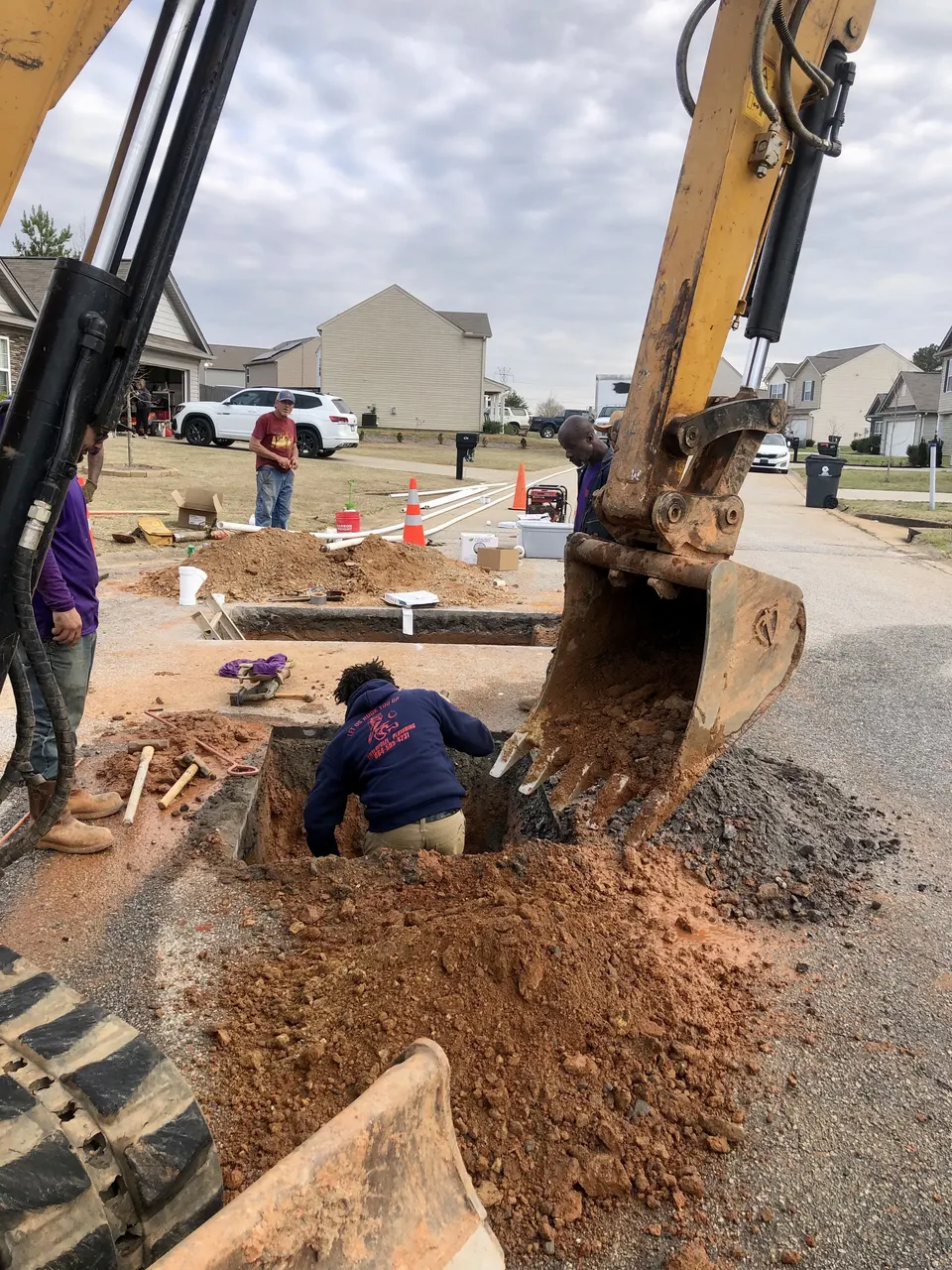
When the failure is a single point — root intrusion, impact damage, one separated joint — the contractor excavates a small area at the located leak, replaces the failed section, and backfills. Accurate detection is what keeps this excavation small: dig once, in the right place.
Trenchless Replacement
If the line is old galvanized steel, has leaked before, or shows corrosion beyond the immediate failure, spot-repairing it is usually postponing the inevitable. Directional boring pulls a new HDPE line beneath the yard, driveway, and landscaping without open trenches, so replacement no longer carries the surface-restoration cost that made it painful with traditional excavation. See our water line replacement service for how the trenchless process works.
Detection + Repair Bundling
Using one contractor for both steps typically costs less than paying a standalone detection company and then a separate repair crew. The detection visit doubles as the repair estimate, mobilization happens once, and the detection fee is often absorbed into the repair price. Since Sloan Underground's estimates are free, the practical cost of the "find it" step on a bundled job is frequently zero.
Frequently Asked Questions
How much does it cost to find a water leak in South Carolina?
Professional water leak detection typically costs $150–$600 for most residential properties in South Carolina, based on typical industry pricing as of 2026. Simple, accessible leaks sit at the low end; long service lines, slab foundations, and leaks needing acoustic or line-tracing equipment push toward $600–$1,200+. Sloan Underground provides free estimates — call (864) 386-1649.
Is there a free way to check for a water leak before paying anyone?
Yes. Shut off every fixture and water-using appliance in the house, then watch the leak indicator (small triangle or dial) on your water meter for 10 minutes. If it moves with everything off, you have an active leak. Closing the main interior shutoff narrows it further: continued movement means the leak is in the underground line between the meter and your foundation.
Does the water utility ever cover leak detection or repair?
If the leak is on the utility side of the meter — between the main and the meter itself — it is the utility's responsibility, and they locate and repair it at no charge to you. Everything from the meter to your house is the homeowner's. Many South Carolina utilities also offer a one-time leak adjustment credit on the bill after you document a repair, so ask your provider before paying the inflated bill in full.
How much water does an underground leak actually waste?
A pinhole leak in a pressurized service line can lose hundreds of gallons a day, and a joint separation or crack can lose 1,000+ gallons daily. As an illustration, a 500-gallon-per-day leak is roughly 15,000 gallons a month — at combined water and sewer rates of roughly $8–$15 per 1,000 gallons, typical for SC utilities, that is an extra $120–$225 on a single monthly bill.
Should I repair the leak or replace the whole water line?
It depends on what detection finds. A single failure point on an otherwise sound line — root intrusion, impact damage, one bad joint — usually justifies a spot repair. Multiple leaks, corroded galvanized pipe, or a line already past its service life usually make trenchless replacement the better long-term spend, since a spot repair on a failing line only buys time before the next dig.
Related Articles
Water Leak Detection in the Upstate
How leaks behave in Piedmont red clay, and what Upstate homeowners should expect from the detection process.
Read article
Leak Detection in the Midlands
Why sandy Midlands soils hide leaks longer — and how detection works around Columbia-area properties.
Read article