
Directional boring installs water, gas, electric, fiber, and conduit lines underground without digging a trench — a drill rig steers a bore path beneath your property, then pulls the new line back through it. In Mills River, NC, short residential bores typically cost $1,500–$3,500, with long rural runs and creek crossings scaling from there. For the large lots, long driveways, and working farmland that define the Mills River valley, it's usually the only method that doesn't tear up the ground you actually use.
How Directional Boring Works
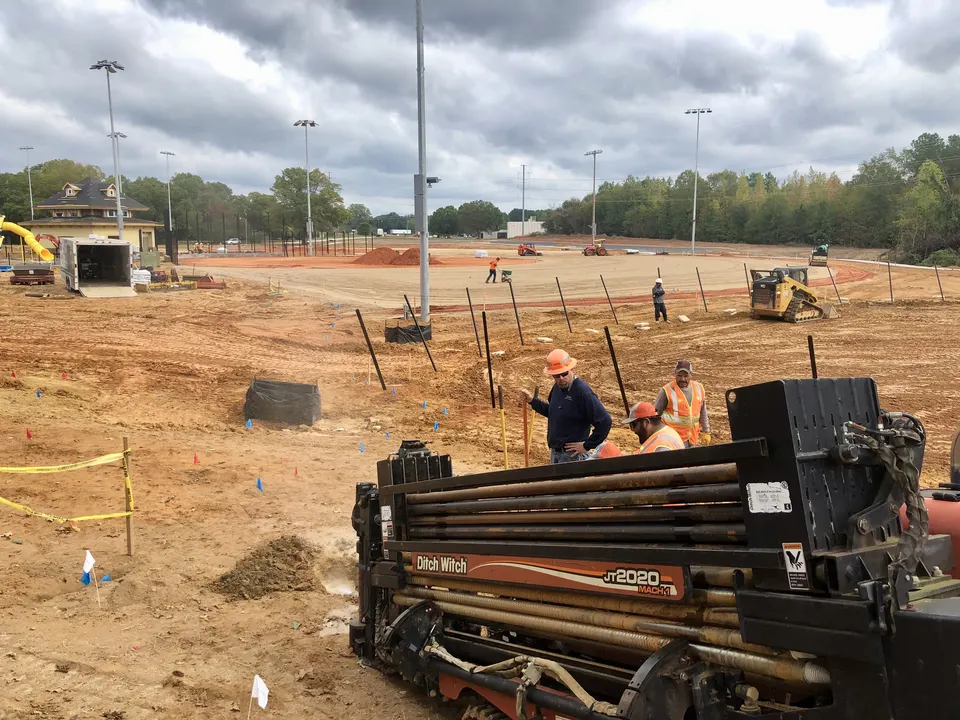
Horizontal directional drilling (HDD) happens in three passes. First, the rig drills a small-diameter pilot bore along a planned underground path — the operator steers it around obstacles and under whatever needs protecting, guided by a locator walking the surface. Second, the bore is back-reamed to the diameter the new utility needs. Third, the product line — HDPE water pipe, gas line, electrical conduit, or fiber duct — is pulled back through the finished bore in one continuous run.
The only excavation is a small entry pit and exit pit at each end of the shot. Everything between them — lawns, driveways, pasture, nursery rows, creek beds — stays untouched. Compare that to open trenching, which cuts a continuous scar from point A to point B and leaves you re-grading, re-seeding, and re-graveling everything in the line's path. Our full horizontal directional drilling page covers the equipment and process in more depth.
Why Mills River Properties Are Built for Boring
Mills River is not a town of small city lots. Since incorporating in 2003 it has stayed a place of large rural parcels, long gravel driveways, and working agricultural land — the Mills River valley is one of Western North Carolina's biggest nursery and vegetable-growing areas. That property profile changes the utility math:
- Long service runs. A home set 300+ feet off the road needs a long water or power run. Trenching that distance crosses everything in between; a bore goes under it in one shot.
- Working ground. Nursery rows, planted fields, and irrigated pasture are income-producing land. An open trench through them costs more than the scar — it costs production. Boring keeps the surface working.
- The river itself. The Mills River is a tributary of the French Broad and a regional drinking-water source. Utility crossings near it are exactly where minimal-disturbance methods belong — a bore passes well beneath a creek bed without touching the water or banks.
- Growth on the NC-280 corridor. Between the Asheville Regional Airport and Sierra Nevada's East Coast brewery, the corridor keeps adding homes and commercial sites — most of them needing new underground services put in cleanly the first time.
We built a dedicated Mills River service area page covering everything we bore there, from new-construction utilities to well-line replacements.
What Directional Boring Costs
Pricing follows footage, diameter, and ground conditions. In the Mills River area, the practical ranges look like this:
- Short residential bores ($1,500–$3,500): under a driveway, across a front yard, or a standard service-line replacement.
- Long rural runs ($4,000–$12,000): several-hundred-foot service lines to homes set deep on their parcels, or utilities out to barns, shops, and well houses.
- Complex shots ($8,000–$20,000+): creek crossings, road bores, rocky ridge lines, or larger-diameter commercial work.
Rock is the wildcard in every Western North Carolina quote — the valley floor drills easier than the wooded slopes around it, and a bore path that hits granite needs a different head and more time. That's why every quote starts with a site walk. For a deeper breakdown of what moves the number, read our guide to directional boring costs, and if your project is really about getting a line under a driveway, see how we bore under driveways without damage.
What We Install by Bore in Mills River
Every utility Sloan Underground installs goes in trenchlessly: water service lines (new taps, replacements, and well lines), gas lines, underground electric service, fiber and telecom duct, and empty conduit for future pulls. On farm properties, that includes irrigation supply runs and power to outbuildings — the kind of job where the bore path crosses land you can't afford to trench.
Sloan Underground Construction is family-owned, in its fourth generation, and has been boring the Carolinas since 1965. Owner William Sloan is on every job site, and the company is licensed, insured, and bonded in both Carolinas. We run Ditch Witch JT-520 and JT-2020 rigs — enough machine to handle mountain rock without treating a residential yard like a highway project.
Call (864) 386-1649 for a free written estimate on any Mills River bore — most estimates are delivered within 24 hours of the site walk.
Frequently Asked Questions
How much does directional boring cost in Mills River, NC?
Short residential bores — getting a water, power, or conduit line under a driveway or across a front yard — typically run $1,500 to $3,500. Longer runs are where Mills River differs from town lots: a service line reaching a home set several hundred feet off the road, or utilities run to a barn, well house, or shop building, scales with footage and ground conditions, with larger projects ranging $4,000 to $20,000+. Every job gets a free written estimate, usually within 24 hours.
Can you bore long runs on farm and rural property?
Yes — long rural runs are exactly what directional boring is built for. A single bore shot can carry a utility line hundreds of feet under pasture, nursery rows, or a gravel drive without opening a trench across any of it. For working farm and nursery land in the Mills River valley, that means no interrupted irrigation, no cut field access, and no re-grading afterward. We plan entry and exit pits at the edges of working ground so the operation stays out of the way.
Do you bore under creeks and streams near Mills River?
Yes. Boring beneath a creek is one of the strongest use cases for trenchless installation, because the drill path travels well below the bed without disturbing the water, the banks, or anything living in it. That matters in the Mills River area, where the river is a regional drinking-water source — open-cutting a crossing is the kind of disturbance nobody wants. Crossings are planned with the required permits and utility locates before any drilling starts.
Related Articles
Directional Boring Cost Guide
The full cost breakdown — footage, diameter, soil, rock, and what a written HDD quote should include.
Read article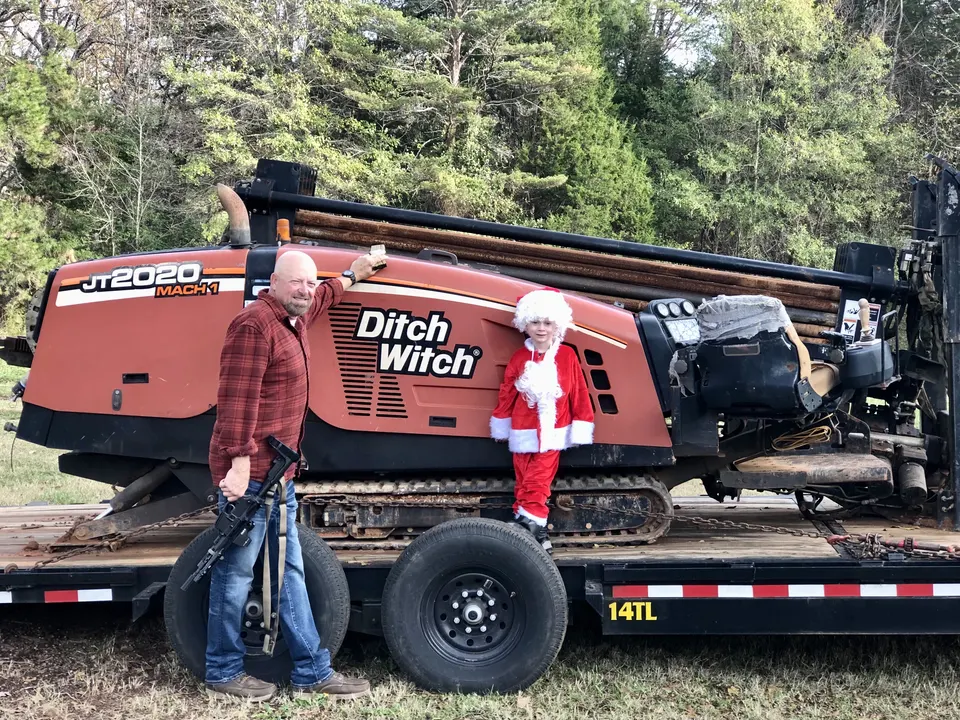
Bore Under a Driveway Without Damage
How a trenchless bore gets a utility line under concrete or gravel with nothing to patch afterward.
Read article
Replacing a Water Line on a Steep WNC Mountain Property
Boring vs trenching on a mountainside, what rock and frost depth change, and honest WNC costs.
Read article