
Yes — directional boring goes entirely underneath your driveway. A small entry pit on one side, a small exit pit on the other, and the drill travels beneath the slab at 18–36 inches of cover. The driveway surface is never touched. Concrete, asphalt, pavers, gravel — it doesn't matter what the driveway is made of.
Yes — Directional Boring Goes UNDER Your Driveway
Horizontal directional drilling (HDD) is a guided underground boring technique. A drill head enters the ground at a shallow angle, travels underground along a steered path, and exits on the far side. For a driveway crossing, that means:
Entry Pit
A small pit — typically 3 to 4 feet wide and 3 feet deep — is hand-dug on one side of the driveway. This is where the drill rig sits and where the boring begins.
Underground Bore Path
The drill head steers below the slab at minimum 18 inches of cover below the bottom of the concrete. A walkover locating system tracks the drill head's exact position and depth in real time. No guesswork.
Exit Pit
A matching pit is excavated on the far side of the driveway, where the drill head emerges. The entry and exit pits are the only surface disturbance on the entire job.
Product Pullback
After the pilot bore is complete, a reamer enlarges the hole to the required diameter. The pipe, conduit, or utility product is then pulled back through the bore path in a single continuous run.
The driveway sits undisturbed above the entire operation. After product pullback, the entry and exit pits are backfilled and compacted. On most residential jobs, there is nothing left behind that the homeowner needs to fix.
Want to understand the cost before you commit? Our detailed guide covers directional boring costs in South Carolina — including per-foot rates, job type price bands, and what drives the price up or down in Upstate SC.
What Types of Driveways Can Be Bored Under?
All of them. The driveway surface material has almost no bearing on whether a bore is feasible. What matters is the soil beneath the slab — and in Upstate South Carolina, our crews have bored through Piedmont red clay, decomposed granite, sandy creek-bottom soils, and rocky outcrops in Pickens and Greenville Counties.
Concrete
The most common residential driveway surface. Standard 4-inch slabs with 18 inches of sub-base clearance are straightforward. Reinforced slabs or deeper footings require deeper bore paths — we adjust accordingly.
Asphalt
Asphalt driveways typically have 2–4 inches of material over compacted sub-base. No special treatment required — boring depth targets the same 18+ inches below slab bottom regardless of pavement thickness.
Pavers
Concrete and brick paver driveways are actually easier to preserve than continuous concrete — the entry and exit pits can be sized to avoid disturbing the paver field entirely, and any disturbed pavers lift and reset cleanly.
Gravel & Stone
Gravel driveways have no rigid slab, which means less constraint on entry-pit placement. The bore still targets the same depth clearance. Gravel restoration after pit backfill takes about 20 minutes.
One thing that does affect driveway boring: the soil directly under the slab. Clay-heavy Piedmont soils — the dominant subsurface in Greenville and Spartanburg counties — hold their bore hole cleanly and are among the most favorable conditions for HDD. Sandy or gravelly sub-base soils require bentonite drilling fluid formulation adjustments to prevent hole collapse. Our crews have seen it all across Upstate SC.
How Long Does a Driveway Bore Take?
A standard residential driveway bore — one utility, one bore path, typical 20–80 foot crossing — takes 4 to 8 hours from equipment setup to backfilled pits. That includes:
- Machine setup and utility locating verification: 30–60 minutes
- Entry and exit pit excavation: 30–60 minutes
- Pilot bore: 1–2 hours depending on length and soil
- Reaming (if required for larger diameter products): 30–60 minutes
- Product pullback: 30–60 minutes
- Pit backfill and compaction: 30–45 minutes
- Cleanup and demobilization: 20–30 minutes
Multiple utility passes on the same bore path add time per pass — a second conduit through the same bore adds roughly 1–2 hours. If you need both a water line and an electric conduit pulled, combining them on one mobilization cuts total cost significantly compared to separate trips.
Our horizontal directional drilling service page covers the full equipment lineup and typical project timelines for larger commercial jobs.
What Can Be Installed Under a Driveway?
Anything that comes in a continuous product form that can be pulled through a bore hole. In practice, that covers virtually every utility a residential or commercial property needs:
Water Lines
HDPE or PEX service lines, 3/4″ to 2″ for residential, up to 6″ for commercial mains. See our water line installation service and the related guide on how to install a water line without damaging your yard.
Gas Lines
PE-2708 HDPE natural gas distribution pipe. Residential service lines (1″–2″) are the most common driveway crossing for new home builds and service line extensions from the meter.
Electric Conduit
Schedule 40 PVC or HDPE electrical conduit, typically 2″–4″. The wire is pulled by the electrician after we've completed the bore and conduit installation. We install the conduit; your electrician pulls the wire.
Fiber Optic
Innerduct or sub-duct for internet and communications fiber. Small diameter (1″–1.5″) and light pullback force make fiber installs some of the fastest driveway bores we do.
Irrigation Lines
Poly pipe for landscape irrigation systems crossing under driveways to reach island plantings, back yards, or detached garden areas. Multiple small lines can often be pulled in a single bore pass.
Conduit for Data / HVAC / AV
Low-voltage conduit for data lines, security camera runs, intercom, audio/video — anything that needs to reach a detached garage, workshop, or outbuilding without an open trench across the driveway.
Frequently Asked Questions
Will boring damage my concrete driveway?
No. Horizontal directional drilling works entirely beneath the surface. The only disturbance is a small entry pit on one side of the driveway and a small exit pit on the other — both well outside the concrete slab. The driveway surface is never touched, never cracked, and never needs repair after the bore.
Can you bore under a new driveway?
Yes, and it is often the smarter sequence. Boring under an existing driveway costs the same as boring under a new one. But if the driveway has not yet been poured, boring the utility conduit first and then pouring the concrete over it is faster, cleaner, and eliminates any risk of surface disruption entirely. We routinely coordinate pre-pour bores with general contractors across Upstate SC.
How deep do you bore under a driveway?
Minimum 18 inches below the bottom of the slab — which means 22–26 inches below the finished surface on a standard 4-inch concrete driveway. Our typical residential driveway bore runs 24–36 inches of total cover. Deeper bores add cost but are sometimes required by utility company specs or local code.
What is the maximum driveway bore length for one machine setup?
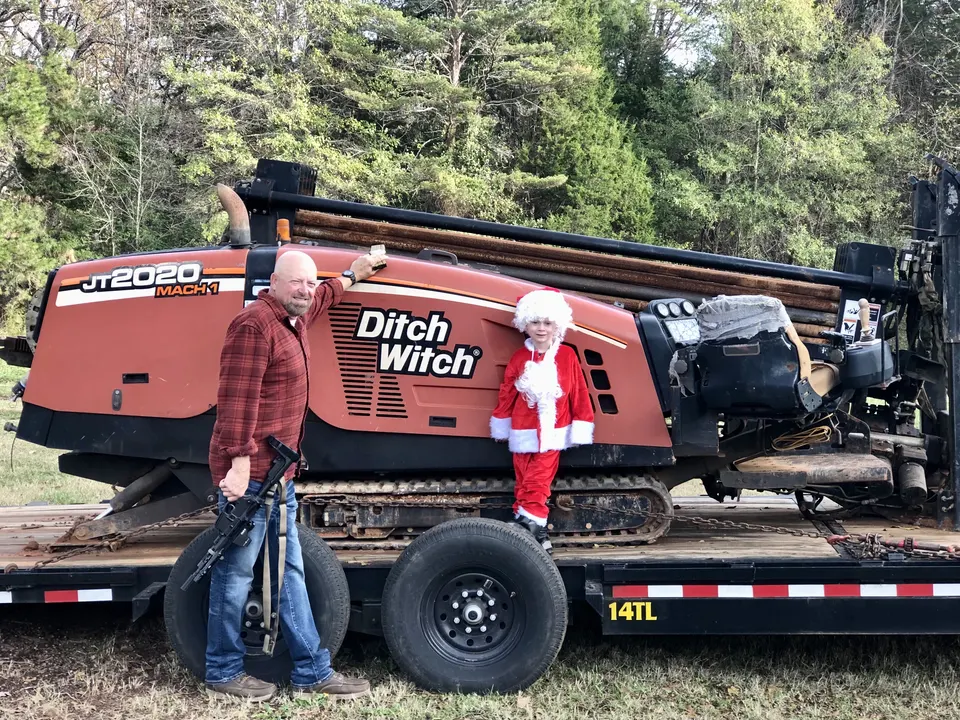
Our Ditch Witch JT-5, the machine we use for most residential driveway bores, handles up to 150–200 feet of drill rod in a single setup. Longer runs — extended driveways, multiple crossings, or runs to a detached structure — shift to the JT-520 or JT-2020 depending on total footage and soil conditions. There is no job too long to quote; we simply size the machine to the bore.
Related Articles
Directional Boring Cost in South Carolina
Real price ranges for SC boring jobs — driveways, road crossings, commercial runs — and what drives the cost up or down.
Read article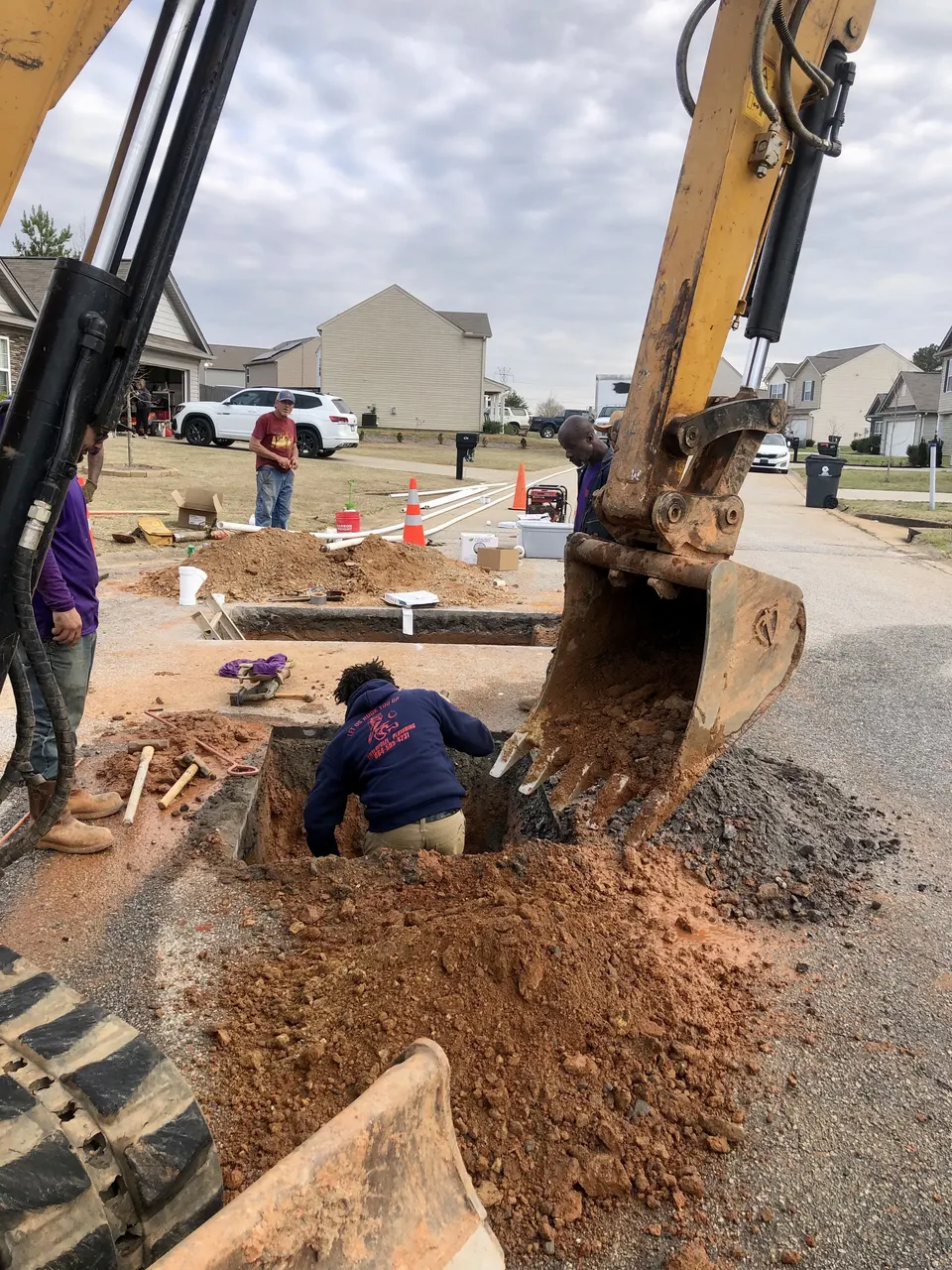
Install a Water Line Without Damaging Your Yard
How trenchless water line installation protects your landscaping, hardscape, and trees — and what traditional trenching actually destroys.
Read article
How to Replace a Water Line Under a Retaining Wall
The wall stays: boring beneath the footing and drainage zone, pit to pit, with the backfill never opened.
Read article